


Diversity in Hockey: Is the NHL Even Trying?
- Ryan Turell

- Jan 11, 2021
- 6 min read
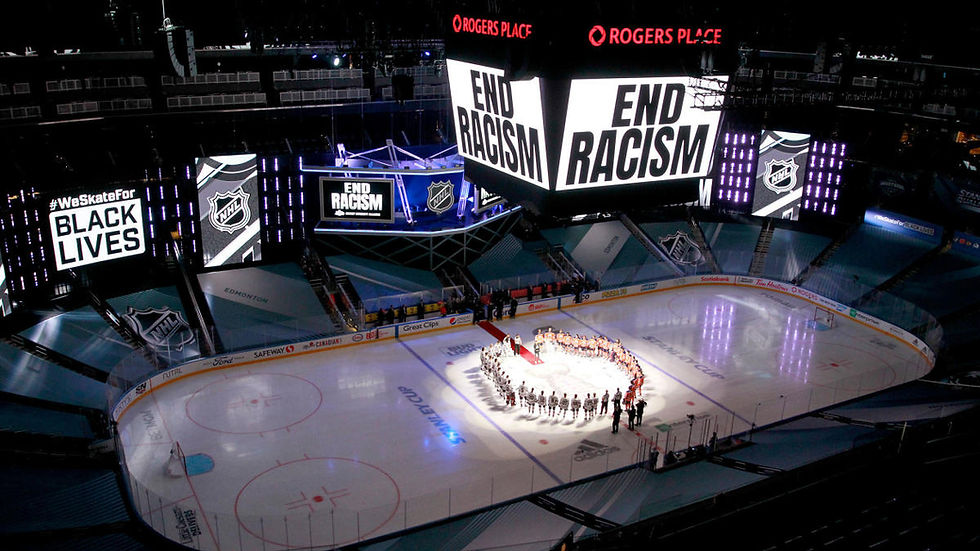
Hockey is one of the four "major sports" in the United States, but like many other things in this country it is disproportionately white. This "whiteness" is apparent in any given hockey game, from junior hockey up to the National Hockey League. Hockey has often been dubbed as a white sport as well as a Canadian sport. While both of those might be stereotypically true, diversity—or lack thereof—in hockey is much deeper than a stereotype.
The Unfortunate Reality
Hockey is an expensive sport to play: from equipment to skating lessons to ice time, the costly factors quickly add up. Scotiabank and FlipGive surveyed over 1,000 American and Canadian hockey parents to see how much money they spend on their kids to play hockey. 60% of the respondents said they pay more than $5,000 annually on hockey-related expenses, 41% spend $5,000-$10,000 and 16% of respondents said they spend more than $10,000 per year for their children to play hockey. In the same study it was reported that 35% of the parents surveyed had to take on personal debt, with 23% of the respondents citing that they took on a second job to help pay for their child's hockey. Concurrently, in the United States and Canada there is an enormous racial wealth gap. According to Census data, in 2018 the average income for white households was $68,145. However, per the same data, the average income for Black families was nearly $30,000 lower, at $40,258. This is the lowest average income for any racial group in the United States. There is a much smaller wealth gap in Canada, which happens to be about CA$9,000 (~70,000 compared to ~61,000). It is estimated that if a child starts playing hockey at three years old until the time they are 18, it will cost around $80,000. The expensive nature of hockey breeds a culture of exclusivity, as hockey is a steep price for most Americans but, due to the massive wage gap, is generally unaffordable for Black families. The financial burden of youth hockey is a significant piece of the puzzle, but it is not the only factor in why hockey is an overwhelmingly white sport.
Another issue evident whenever someone turns on a broadcast is the lack of Black players, which led to the introduction of the stigma that hockey is a white sport. This, combined with the lack of opportunity for minority children to play hockey due to financial constraints, set up a racial barrier. The NHL has done some work to make the sport more inclusive and grow the game—but evidently not nearly enough.
Refusal to Acknowledge the Problem
Hockey is the national winter sport of Canada and is fundamentally thought of as a Canadian sport. However, while racism is prevalent in Canada, it is thought of as an American issue and thus not closely associated with hockey, even though it is incredibly prevalent. Black children are being turned away from their nation's game because of racism, as well as the fact that there are so few Black players in the NHL that young kids can look up to as role models. The longtime—and now former—Hockey Night in Canada host Don Cherry has a long history of racist tirades dating back well over a decade. He was finally fired in 2019 after a highly derogatory rant about immigrants. Ironically, in a previous rant, Cherry said hockey was the one sport completely free of racism.
The NHL Today
While Cherry clearly follows hockey incredibly closely, his remarks were clearly not in tune with how the diversity of the sport compares to others. The NHL has 42 active Black players, which amounts to 5.7% of the total players. According to The Institute for Diversity and Ethics in Sports, the next lowest in the four major sports is Major League Baseball, which consists of 39.8%, Black players. The NHL's number is staggering and, quite frankly, embarrassingly low. With the lack of diversity on the ice, people are not accustomed to seeing Black hockey players. JT Brown, a Black NHL player, has spoken publicly about this issue: when he mentors kids at hockey camps, there are always kids who are shocked that he plays hockey because of his skin color. Black and other hockey players of color experience racism in a variety of ways with one common message: they are the outsiders in a predominantly-white sport. In a 2012 preseason game, then-Philadelphia Flyers forward Wayne Simmonds, who is Black, had a banana thrown at him from a fan in the crowd. This, like any other racist action, was not an isolated incident. There have been countless instances on record of racism in hockey.
Historically, the NHL has always been the last league to join the fight against racism—an indication of this was the fact that they were the only professional league to play games following the Jacob Blake shooting last August. After the news broke that the NBA was boycotting games, the NHL had two games left on their slate. The league announced that there would be a moment in pregame for reflection, which happened before the Lightning-Bruins game. However, the late-game that night, the Stars-Avalanche game, featured no acknowledgment of the day's events whatsoever. The NHL has spent far too long ignoring the problem, and the league is alienating its players by doing so.
Hockey Diversity Alliance
In response to the George Floyd shooting last May, seven current and former NHL players formed the Hockey Diversity Alliance (HDA) to help grow hockey diversity. The group operates independently of the NHL, but their original goal was to create a partnership between the two organizations. Last August, the HDA sent a list of formal requests to the NHL about diversifying employment through the league and hiring Black personnel to both hockey and non-hockey related positions. However, the NHL did not meet the HDA's requests, and in October 2020 the two organizations announced that they would operate independently of each other but share a common goal. Players involved in the HDA went on record to say how they were discouraged, as well as how it felt like the NHL did not have their back. The HDA formally requested that the NHL cancel the games in response to the Jacob Blake shooting. Ultimately, the league did not decide to cancel the games. However, over 100 players got on the phone together and decided collectively not to play. It was the player's choice, and this one action by the players was more than the league had ever done for players of color.
The NHL has not done anything, in all fairness, but it is far from enough. The NHL has set up a "Hockey is for Everyone" program, where the league has partnered with over 20 grassroots organizations to help use hockey to promote other life skills. Many of these charities and programs exist in less affluent areas where the kids usually cannot afford to play hockey. The league has also created different counsels for players, front office executives, youth hockey and fans to promote diversity.
While the NHL is taking some steps to help grow the game, there have been a few misses along the way. The NHL first celebrated Black History Month in 2019, and in 2020 the league released two commercials about diversity and inclusion. However, neither commercial featured a Black player. A mistake like this is a clear oversight, but one the league had plenty of opportunities to fix. The commercials were shot in September during the NHL media tour but not aired until February. There were plenty of chances to remedy this mistake in the five months between, including at the All-Star Game in January, which featured two Black players: Seth Jones and Anthony Duclair. While it was a small action by the NHL in the grand scheme of things, it is telling in how the league has been run and has treated the importance of diversity.
Hockey is a reasonably exclusive game and cannot continue to be this way. As the world continues to diversify, hockey needs to do the same or be left behind. I leave you with a quote by Matt Dumba, a defenseman for the Minnesota Wild.
"Hockey is a great game, but it can be a whole lot greater"



Comments